
A packaging partnership that started with a cautious trial and scaled 4× within months.
Industry: Electronics / Automotive / LED Manufacturing | Region: Asia-Pacific & Global Supply Chain
Client Profile
A mid-size electronics manufacturer supplying precision assemblies to automotive, LED, and industrial OEMs across Europe and North America. The company operates multiple SMT and final-assembly lines and ships tens of thousands of ESD-sensitive modules per month.
For confidentiality, we refer to this client as "TechModule Co."
The Challenge
TechModule Co. faced a set of packaging problems common in high-mix electronics manufacturing:
· ESD compliance pressure: Their automotive OEM customers required all WIP and shipping containers to meet ANSI/ESD S20.20 surface-resistance specifications (10⁴–10⁸ Ω). Failing a line audit could mean losing a contract.
· Product diversity: They needed to pack two very different product profiles — small, multi-piece sensor modules (requiring grid-style separation across multiple layers) and a long, hollow-profile assembly (requiring custom foam-cradle protection with internal channel support).
· Cost of disposable packaging: Their legacy approach — ESD bags inside generic cardboard cartons with loose-fill foam — was labor-intensive to pack, inconsistent in protection, and generated significant waste. Each carton was single-use.
· No single supplier: Boxes came from one vendor, foam from another, dividers from a third. Lead times were unpredictable, and no one owned the overall packaging design.
The Solution
We proposed a two-SKU custom ESD tote system — designed, prototyped, and manufactured as complete assemblies:
SKU 1 — Compact Multi-Layer Divider Tote
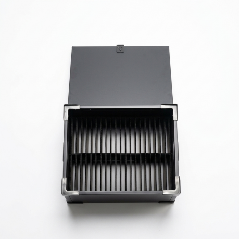
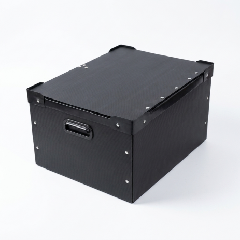
· 5 mm twin-wall ESD corrugated polypropylene, surface resistance 10⁴–10⁸ Ω
· External 465 × 365 × 240 mm; internal 445 × 345 × 230 mm
· Hinged lid with latch, dual carry handles, four corner reinforcements
· Three fixed-position divider layers — each die-cut to create individual cells matching the module footprint, each layer pinned to the box base to prevent any shift
· Gram weight: 850 g/m² — engineered for 4-high stacking on pallets
SKU 2 — Long-Profile Foam-Cradle Tote
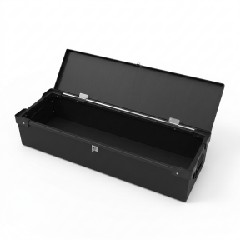
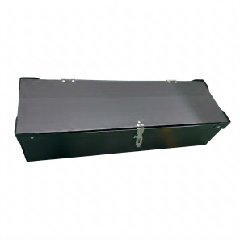
· 5 mm twin-wall ESD corrugated polypropylene, surface resistance 10⁴–10⁸ Ω
· External 820 × 230 × 190 mm; internal 800 × 210 × 180 mm
· Hinged lid with latch, dual carry handles, four corner reinforcements
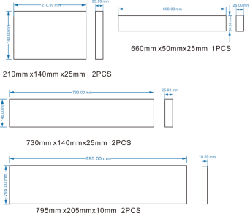
· Seven-piece white EPE foam insert system:
· - 2 × top/bottom full-coverage pads (795 × 205 × 10 mm) for surface cushioning
· - 2 × long side walls (730 × 140 × 25 mm) for lateral protection
· - 2 × end walls (210 × 140 × 25 mm) for axial retention
· - 1 × internal support strip (660 × 50 × 25 mm) inserted into the product's longitudinal channel to brace the hollow structure from within
· Holds a single long-form assembly — the foam cradles the product externally while the support strip prevents cross-sectional deformation of the hollow profile
· Gram weight: 950 g/m² — heavier grade for the elongated form factor
DESIGN DECISION — Why non-ESD foam inside an ESD box: The client's initial brief asked for ESD foam throughout. After reviewing their product handling flow, we recommended standard white EPE instead. The ESD corrugated shell already forms a complete dissipative enclosure; duplicating the ESD function in the foam would add 40–60% to the insert cost with zero incremental protection. The client's ESD engineer agreed, and the cost saving helped justify the project internally.
The Results
|
Order Growth |
Volume per Order |
SKU Expansion |
Audit Pass Rate |
|
4× |
50 → 200 units |
1 → 2 SKUs |
100% |
Phase 1 — Trial (Month 1–2)
TechModule Co. ordered 30–50 units of SKU 1 only. The boxes were deployed on two SMT lines for a 60-day field trial. Key validation points:
· Surface resistance tested at incoming QC and after 60 days of daily use — all units within 10⁴–10⁸ Ω spec.
· Three-layer dividers held position with no loosening or warping.
· Operators reported faster pack/unpack cycles compared to the old bag-in-box method.
· Zero ESD-related rejects during the trial period on the two pilot lines.
Phase 2 — Rollout + New SKU (Month 3–4)
After a successful trial, TechModule Co. rolled out SKU 1 across all assembly lines, increasing the order to 150 units. Simultaneously, they brought us a new challenge: their long-profile assembly line had no dedicated ESD tote for a 730 mm hollow-channel product. We designed SKU 2 from scratch — the foam-cradle tote with internal support strip — with a prototype delivered in 5 days and production in 10.
Phase 3 — Standardization (Month 5+)
Both SKUs became the standard WIP container across TechModule Co.'s facility. Repeat orders stabilized at 150–200 units per cycle across both models. The client also began requiring their sub-suppliers to use the same ESD tote system for incoming materials, further expanding demand.
Why the Orders Grew: Value Analysis
1. Measurable cost reduction
Each reusable ESD tote replaces approximately 80–120 single-use bag-plus-carton sets over its lifecycle. At an average disposable packaging cost of ¥3–5 per set, one tote pays for itself within 30–40 uses — typically within 2 months of daily rotation.
2. Line efficiency gains
The old workflow: take product out of ESD bag → place in temporary tray → close bag → tape carton. The new workflow: place product in divider cell or foam cradle → close lid. Operators estimated a 30–40% reduction in packing time per unit.
3. Product-specific protection engineering
The internal support strip in SKU 2 solved a recurring problem: the client's hollow-profile assemblies were arriving at customers with micro-deformation in the channel walls due to stacking pressure in transit. By bracing the hollow section from within, the foam strip eliminated this failure mode entirely — a solution that generic packaging could never provide.
4. Audit-ready ESD compliance
When a European automotive OEM audited TechModule Co.'s facility, the ESD tote system was cited as a positive finding — consistent, measurable, documented surface resistance across all WIP containers. This helped TechModule Co. secure a multi-year supply agreement.
5. One supplier, complete solution
Box, dividers, foam inserts (including the internal support strip), and pallets — all sourced and quality-controlled through a single point of contact. When SKU 2 was needed, the lead time from design to delivery was under two weeks, because no third-party coordination was required.
6. Flexibility to scale
No mold fees on repeat orders for SKU 1 (tooling amortized on the first run). SKU 2 mold modification was a one-time USD 50. This low-friction reordering model removed the procurement barrier to scaling up.
"We started with 50 boxes to test on two lines. Within four months, every line in the factory was using them, and we added a completely new box design we hadn't originally planned. That only happens when the product actually solves problems."
— Procurement Manager, TechModule Co.
Key Takeaways
1. Start with a trial, but design for scale. The tote system was engineered from day one to support full-factory deployment — not just a pilot.
2. Match the ESD strategy to the application. Static-dissipative shell (10⁴–10⁸ Ω) + standard cushioning foam is the cost-optimal architecture when the box is the primary EPA container.
3. Internal fitment is half the product. The three-layer fixed dividers and the seven-piece foam cradle system (with internal support strip) are what make these boxes functional — not just the corrugated shell.
4. Understand the product geometry. The low-profile support strip bracing a hollow channel is a detail that only emerges from studying the actual product — not from a generic packaging catalog.
5. Reusable packaging pays for itself fast. The breakeven point is typically 30–40 cycles — well within the first quarter of use.
READY TO REDUCE ESD RISK AND PACKAGING COST?
Whether you need 50 totes for a pilot line or 5,000 for a global rollout, we design and manufacture complete ESD corrugated packaging systems — box, inserts, and logistics-ready pallets — tailored to your product dimensions and compliance requirements.
Request a free sample and packaging design consultation.